
The 20-Minute Marriage Meeting: A Weekly Agenda That Fits Real Life
A marriage meeting is a short, planned conversation where you and your spouse appreciate each other, share how the week felt, talk through one concern, and agree on what comes next. Twenty minutes once a week is enough to start.
You probably talk all day. You know who’s running late, what needs buying, and which bill is due. Yet you can finish the week knowing more about the schedule than about how your spouse is actually feeling.
A marriage meeting makes room for both. It doesn’t need to be formal or awkward. It only needs a regular time, a few good questions, and a clear way to end.
At a glance
Time: 20 minutes
How often: Once a week
Bring: One appreciation, one thing you want your spouse to understand, and a willingness to listen
Leave with: One small agreement you’ll revisit next week
What do you talk about in a marriage meeting?
A useful weekly meeting covers four things: appreciation, each person’s experience of the week, one issue that deserves attention, and plans for the days ahead.
At Happy & Married, the Reflect & Connect Method pairs individual Weekly Check-Ins with a conversation together. The Check-In is your private reflection. The Marriage Meeting is where you discuss what you choose to bring forward. That gives the meeting a purpose: understand each other’s experience, then decide what to do with what you learn.
A simple 20-minute marriage meeting agenda
Use these timings as a flexible guide. Some weeks you’ll spend longer celebrating, and other weeks you’ll need more time to understand a concern.
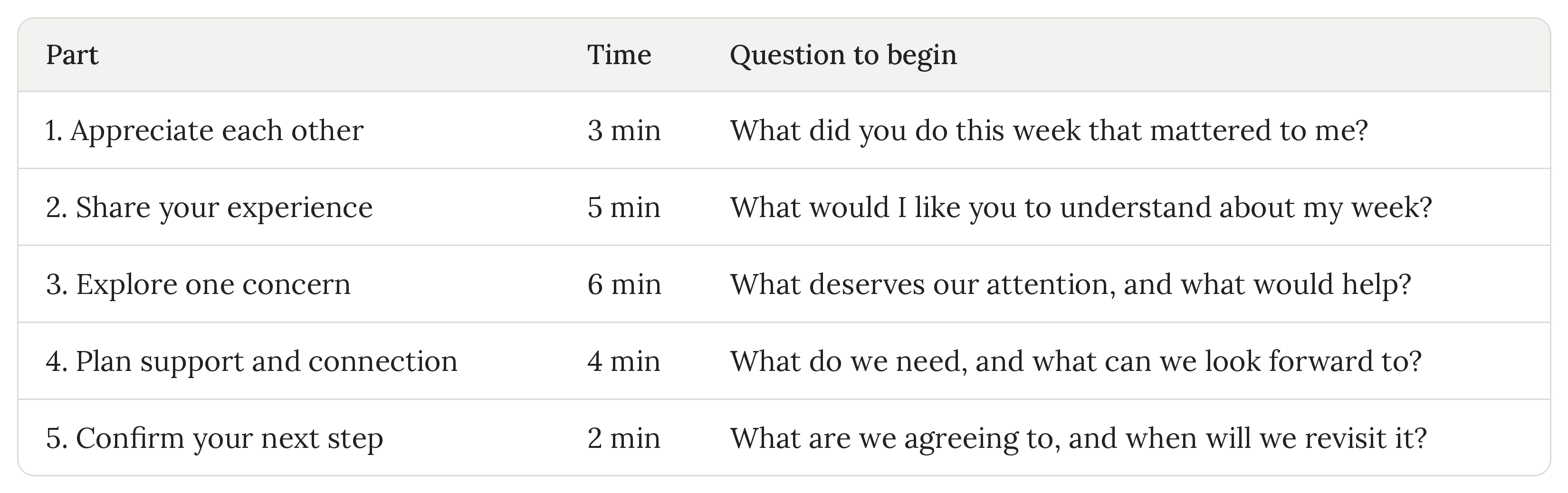
1. Appreciate something specific
Tell your spouse about a moment you noticed and why it mattered. For example: “When you asked about my appointment and stayed to listen, I felt cared for.”
Let the appreciation land on its own. Don’t attach a complaint to it. The concern gets its own space later.
2. Share how the week felt
Give each person uninterrupted time. You might talk about a moment of closeness, an unexpected stress, something you enjoyed, or something your spouse may not have noticed.
When you’re listening, summarize before offering advice: “It sounds like you were carrying more worry about that decision than I realized. Have I understood?” You can also ask whether your spouse wants listening, help thinking it through, or practical support.
3. Choose one concern to explore
Pick something specific enough to discuss in the time you have, and choose it together. Write down other nonurgent topics for a future meeting. Just don’t use the agenda to dismiss an important need.
The Gottman Institute recommends describing the situation, expressing your feelings, and stating a need without attacking your partner’s character. A request might sound like: “I’ve missed spending time together after dinner this week. Could we choose an evening to put our phones away and sit together?”
Ask what’s realistic for your spouse, too. Work toward an agreement you both understand and willingly accept.
4. Plan practical support and something enjoyable
Look at the week ahead. Is there an appointment, a demanding workday, a household task, or a spending decision that needs coordination?
Then make room for connection. Choose something you both want: breakfast together, a shared playlist while cooking, an evening walk, or a date you’ll enjoy anticipating. If laughing together over dinner was a highlight, ask how to make room for more of that.
5. Leave with one clear agreement
Finish by stating what each of you is agreeing to do and when you’ll check back. Use this template:
“This week, we’ll try . Each of us will . At our next meeting, we’ll discuss how it felt and what we want to adjust.”
Keep it small enough to fit your actual week. Thank each other and confirm your next meeting.
How to prepare for your first marriage meeting
Invite your spouse with a specific, manageable request. Explain what you hope the time will make possible. For example: “I miss having time to hear how you’re really doing. Could we try twenty minutes on Sunday to talk about our week and choose something we’d enjoy doing together?” Let your spouse help choose the time and format. A walk might suit one couple, and coffee at the kitchen table might suit another.
Choose a time when neither of you needs to rush. If a topic needs longer, agree on when to return to it. You don’t have to resolve everything in one sitting.
Reflect individually first. Happy & Married’s free Weekly Check-In helps you reflect privately across the important areas of your marriage before you talk. Each spouse completes it separately, and you decide what to share. Completing it is not an obligation to disclose every answer.
Agree on ground rules. Take turns, avoid insults, and ask for clarification when something lands badly. Either person can request a pause. If you pause, set a realistic time to reconnect rather than leaving the conversation unfinished.
Marriage meeting questions to get you started
Not sure how to open? Pick one or two:
What was the best moment of our week together?
Is there something I did this week that you appreciated?
When did you feel most connected to me recently?
Was there a moment you felt alone or overlooked?
What’s one thing that would make next week easier for you?
What’s something we both want to look forward to?
What this can sound like: a sample conversation
This example is hypothetical. Sam and Jordan both say they miss feeling connected in the evenings. During their meeting, they discover they have different needs after work.
Sam: “I’ve felt lonely after dinner lately. I’d like some time when we’re both available to each other.”
Jordan: “I want that, too. I’ve been going quiet because I’m exhausted. Could I have a little time to decompress first?”
Sam: “That makes sense. Would Tuesday and Thursday at eight work for twenty minutes together?”
Jordan: “Yes. Let’s try tea on Tuesday and a short walk on Thursday.”
Their agreement is specific: two evenings, an agreed time, and something each person is willing to try. At the next meeting, they can ask whether those moments felt connecting, whether the timing worked, and what they want to keep. If one evening fell through, they can explore the obstacle and revise the plan.
Take your meeting further with a Data-Driven Marriage
One conversation tells you about this week. Repeated reflections show you patterns over time.
Happy & Married Premium brings each spouse’s weekly reflections into a shared picture through relationship trends, insights, and a shared Marriage Score. This is the heart of our Data-Driven Marriage approach: helping couples use what they learn to make more intentional choices.
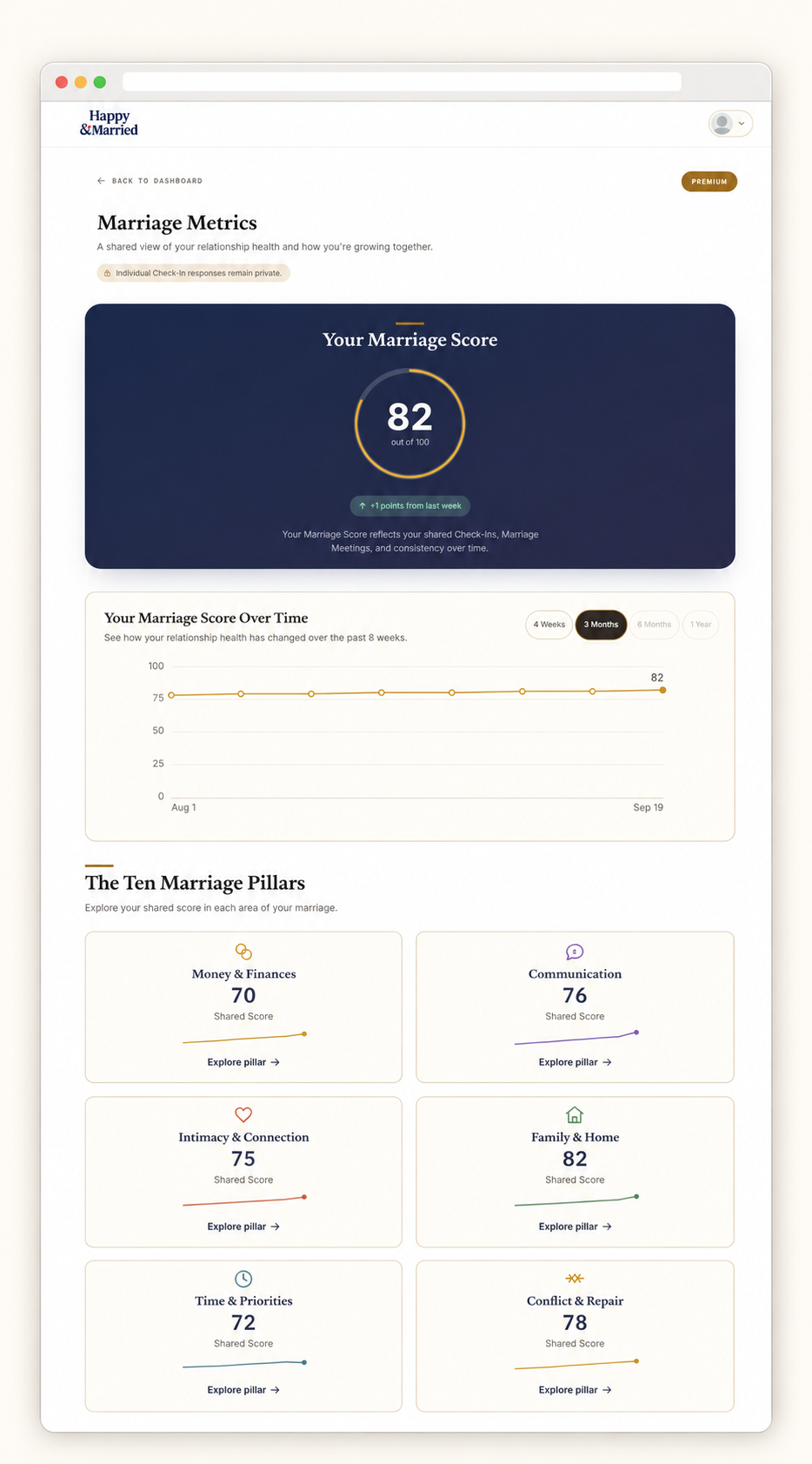
In your meeting, that turns into a better question: “What are we noticing over time, and what would we like to understand?” Maybe connection has felt difficult for several weeks. You can explore that together, choose one small change, and revisit how it felt. Give the same attention to strengths you want to nurture.
These patterns start a conversation. They don’t establish a cause or decide whose experience is correct, and a score reflects reported experiences, not a verdict on your marriage.
When your marriage meeting feels difficult
“My spouse thinks it sounds awkward.” Ask what feels uncomfortable: the name, the structure, the timing, or worry about being criticized. Invite one short conversation and choose the format together. You can complete your own Check-In and leave your spouse free to decide whether to join.
“We spend the whole time on chores.” Keep appreciation and personal reflection near the beginning. If logistics need real time, schedule a separate planning conversation so both get attention.
“We keep having the same discussion.” Look at the agreement you made. Was it clear? Was it realistic? Did you understand the underlying need the same way? Adjust something specific rather than repeating a broad promise. Persistent painful patterns may deserve support from a qualified couples professional.
“We get too upset to continue.” Pause, give yourselves time to settle, and agree on when to return. A scheduled meeting doesn’t require you to push through distress. If there is intimidation, coercion, or fear of retaliation, prioritize individual safety and specialized support. A joint meeting assumes both people can participate freely.
“We missed a week.” Choose the next available time and begin again. Ask whether the original time was realistic, and let the routine adapt to your lives.
Marriage meeting FAQ
How often should married couples have a marriage meeting?
Once a week works well for most couples because it’s frequent enough to stay current and short enough to sustain. If weekly feels like too much at first, start every other week and build from there.
How long should a marriage meeting last?
Twenty minutes is a good starting point. Longer is fine when you need it, but a short meeting you’ll actually repeat beats a long one you dread.
Is a marriage meeting the same as date night?
No. A meeting gives you time to understand each other and coordinate next steps. A date gives you time to enjoy being together. You can plan a date during your meeting and leave the date itself free of agendas.
Do we need a marriage meeting when things are going well?
Yes, if you’d like. Use it to celebrate, understand what has felt good, and make plans you’re excited about. There doesn’t need to be a problem on the agenda.
Should we wait until the meeting to raise something important?
No. Address urgent matters when they arise. The meeting is one more opportunity for conversation, not a rule that delays timely support.
Who should lead the meeting?
Either of you. Many couples take turns opening, or follow the agenda together so neither person feels like the facilitator.
The Happy & Married Team
We help couples build stronger marriages through one simple weekly habit — the Reflect & Connect Method™.